It is not only about the appearance, as a lack of teeth may spoil your confidence, speech, and ability to chew.
The positive side is that current dentistry can offer reliable solutions, and one of the most common ones is a dental bridge. They are to fill the gap created by the loss of one or more teeth. Dental bridges can restore lost function as well as appearance.
Continue reading to understand the different kinds of teeth bridge that are available, their functions and their usefulness to your general denture condition. Moreover, take a look at the considerations that should be made when choosing a type.
What is a Dental Bridge?
A dental bridge is a dental device that is permanent and is used to replace a tooth or teeth. It is obvious from its name that it is just a closure to the gap between teeth or implants. The bridge consists of teeth (pontics), which are false and which are securely attached by your own teeth on each side of that open space, or dental implants.
It is not only that dental braces make you look good, but they also serve to maintain the functions of the mouth, stop other teeth in the mouth from shifting around and regain the normal bite position. A tooth bridge cannot be removed by the patient, as is the case with dentures.
Why Do You Need a Tooth Bridge?
You might need a dental bridge if
- One or more missing teeth
- Difficulty chewing or speaking clearly
- Teeth shifting into empty spaces
- Bite problems or jaw discomfort
Bridges are sometimes seen as a short-term alternative while implants are not an option, or if the teeth on either side of the gap would benefit from being crowned anyway.
Different Types of Dental Bridges
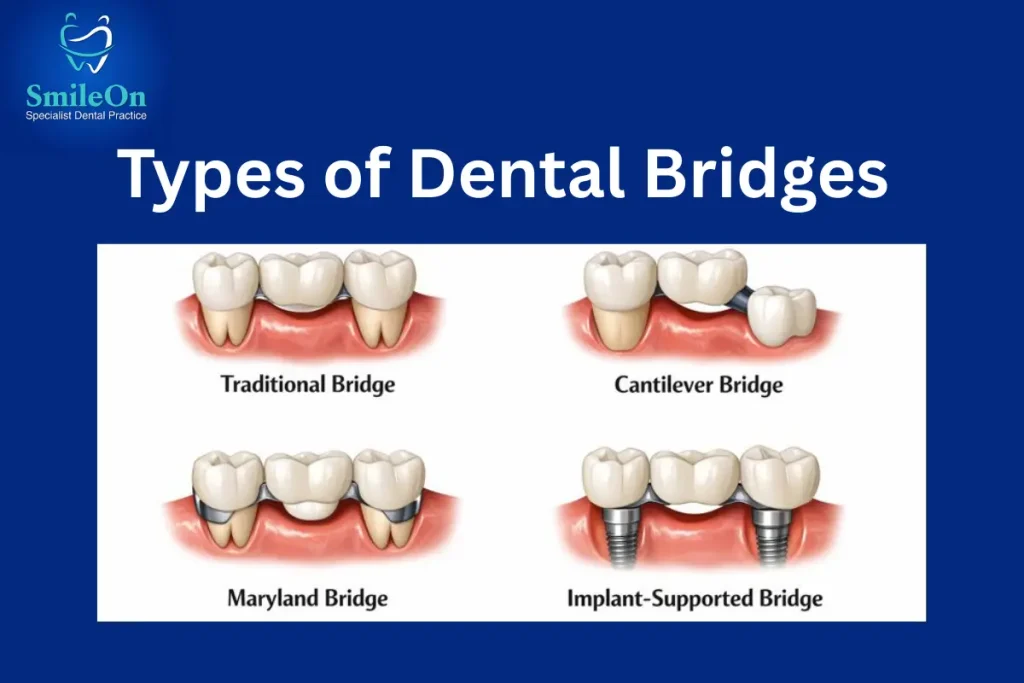
There are different types of it depending on the specific nature of your dental needs. Knowing these alternatives can help you make the right choice.
Traditional Dental Bridge:
The conventional dental bridge is the most commonly used type. It is an artificial tooth or teeth that are held in place by dental crowns that have been cemented onto the surrounding natural teeth.
Key Features:
- Strong and durable
- Long-lasting when properly maintained
- Requires reshaping of adjacent teeth
Cantilever Bridge Dental:
A cantilever bridge is like a regular bridge, but it only has one neighboring tooth to support it rather than two.
Best for:
- Low bite force areas (commonly the front)
- Cases with a single adjacent tooth
Pros:
- Less tooth preparation is required
- Useful in limited cases
Cons:
- Not suitable for molars
- Increased likelihood of the supporting tooth under pressure
Maryland Bridge:
Maryland bonded bridge with a metal or porcelain framework, which can be bonded to the back of your adjacent teeth.
Best for:
- Front teeth replacement
- Patients who prefer minimal tooth reduction
Advantages:
- Conservative option
- Preserves natural tooth structure
- Less invasive than traditional bridges
Limitations:
- Less durable
- Less good for heavy chewing use areas
- For less-demanding cosmetic restorations, the so-called Maryland bridge is also used.
Implant-Supported Dental Bridge:
This bridge is supported by dental implants and not natural teeth. Implants are implanted into the jawbone and function as artificial roots.
Best for:
- Multiple missing teeth
- Patients with good jawbone density
Benefits:
- Extremely stable
- Prevents bone loss
- Long-term solution
Drawbacks:
- Higher cost
- Requires surgery and healing time
A tooth bridge on implants provides greater strength and functionality.
What is a Dental Bridge? How Does it Work?
Common Uses of Dental Bridges
Dental bridges are used to:
- Replace missing teeth
- Restore chewing and speaking ability
- Prevent surrounding teeth from shifting
- Enhance symmetry of the face and smile
The Process of Dental Bridge Treatment
- First Visit: Checkup, X-rays and treatment recommendations
- Tooth/Teeth Preparation: The adjacent teeth are reshaped (if necessary)
- Impressions: Custom bridge is made after molds are taken
- Temporary Bridge: Used to protect teeth that have been prepared.
- Final Placement: The permanent bridge is cemented in place once completed
It usually requires 2 – 3 appointments, depending on the type of tooth bridge.
What are the Pros and Cons of a Dental Bridge?
Pros of Dental Bridges
- Restores smile and confidence
- Improves chewing and speech
- Fixed solution (non-removable)
- Faster than implants in many cases
- Cost-effective compared to implants
Cons of Dental Bridges
- Requires alteration of healthy teeth
- Does not prevent loss of bone (except for implant bridges)
- May need replacement over time
- Decay potential under foundations and crowns
Hence, knowing these advantages and disadvantages can help manage your expectations and help make the right decision.
Tips to Care for Your Dental Bridge
A certain level of care can help keep your teeth bridge in good health for years.
- Brush daily, but avoid aggressive brushing
- Use a bridge floss
- Don’t chew on hard substances, such as ice
- Take regular dental check up
All in all, long-term success depends upon good oral hygiene.
FAQs
How long do tooth bridges last?
The majority of dental bridges, which are fixed, can last anywhere from 5 to 15 years or more with proper oral hygiene and regular dental care.
Is a dental bridge painful?
The technique is generally painless. Local anesthetics are employed and minor discomfort afterward is controlled with medication.
Can a dental bridge be removed and recemented?
A dental bridge can sometimes be removed and recemented if it becomes loose and the supporting teeth are sound.
How many teeth can be on a bridge?
Depending on stability, position, and bite pressure, a dental bridge can replace one or several missing teeth.
Conclusion
Indeed, the best solution is the dental bridge, a reliable and durable tooth replacement. Your choice between a fixed bridge, cantilever bridge, dental or Maryland bridge depends on your dentition state, budget and long-term plan.
However, by scheduling a consultation with an experienced dentist at SmileOn, you can learn which of the dental bridges is best-suited to creating your beautiful, healthy smile.