Dental implants are considered one of the most reliable and long-lasting solutions for replacing missing teeth. They look natural, function like natural teeth, and help preserve the jawbone after tooth loss.
Many patients ask:
- “Can I get my implant and crown in one week?”
- “Can everything be completed during my visit to Pakistan?”
- “Why do I have to wait before getting my permanent tooth?”
These are understandable questions, especially for overseas patients or those with busy schedules.
The answer lies in understanding how dental implants heal.
At SmileOn Dental Clinic, we believe that patients should understand every stage of implant treatment so they can make informed decisions and appreciate why patience is often essential for long-term success.
What Is a Dental Implant?
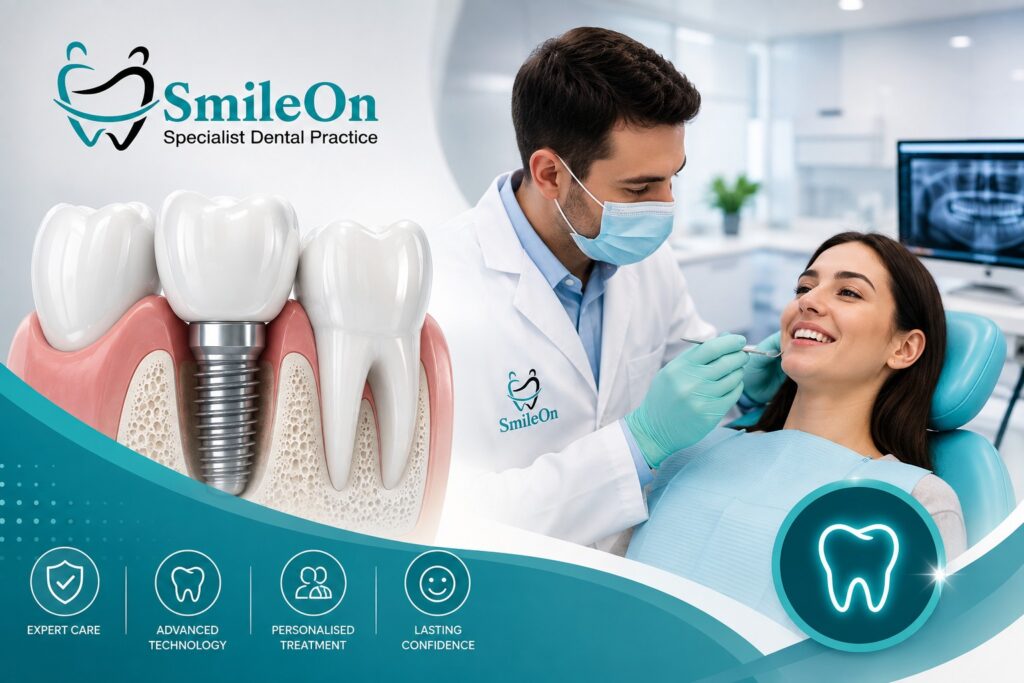
A dental implant is a small titanium post that is surgically placed into the jawbone to replace the root of a missing tooth. It provides a stable foundation for a dental crown, bridge, or denture after healing.
Dental Implant Treatment requires proper healing before the final restoration is placed. During this process, the implant gradually bonds with the surrounding jawbone through a biological process known as osseointegration.
Stage 1 – Consultation and Treatment Planning
Successful implant treatment begins with careful planning.
During the first appointment, your dentist will assess:
- Your medical history
- Gum health
- Bone quality and quantity
- Existing teeth
- Bite relationship
- Oral hygiene
- Smoking habits
- Any previous dental treatment
Diagnostic investigations may include:
- Clinical examination
- Digital radiographs
- OPG (Panoramic X-ray)
- CBCT scan, if required
- Clinical photographs
Every patient is different, which is why implant treatment should always be individualized.
Stage 2 – Implant Placement
Once planning is complete, the implant is placed into the jawbone during a minor surgical procedure.
Depending on the case, the implant may be placed:
- After the tooth has already healed following extraction.
- Immediately after tooth extraction (in selected cases).
- Together with bone grafting if additional bone support is required.
The procedure itself is usually completed in a single appointment. However, implant placement is only the beginning of treatment.
Stage 3 – Osseointegration (The Healing Phase)
This is one of the most important stages of implant treatment. After placement, the surrounding bone gradually heals and bonds directly to the surface of the implant. This natural biological process is called osseointegration. It creates the strong foundation needed to support chewing forces for many years.
Depending on the individual case, this healing period commonly takes 2–4 months, although it may be shorter or longer depending on factors such as:
- Bone quality
- Implant stability at placement
- Implant location
- Bone grafting
- General health
- Smoking
- Oral hygiene
- Healing response
During this stage, the implant is becoming part of the jawbone. Although the implant may feel stable, the biological healing process is still taking place beneath the surface.
Stage 4 – Healing Assessment
Before proceeding with the final restoration, your dentist will evaluate whether the implant has healed successfully.
This may include:
- Clinical examination
- Assessment of implant stability
- Radiographs where required
- Evaluation of surrounding gums
- Confirmation that healing has progressed as expected
Only after confirming satisfactory healing is the implant prepared for the next stage.
Stage 5 – Abutment Placement
An abutment is the connector that joins the implant to the final crown. Depending on the implant system and treatment plan, the abutment may be placed during a separate appointment or as part of the restorative phase. This stage allows the surrounding gum tissue to develop a natural and healthy appearance before the final crown is fitted.
Stage 6 – The Final Crown
Once healing has been confirmed, impressions or digital scans are taken to fabricate the custom-made crown.
The final crown is designed to:
- Match the surrounding teeth
- Restore chewing function
- Provide a natural appearance
- Maintain proper bite
Only after this stage is the implant considered fully restored.
Why Rushing the Crown Is Not Always Recommended
One of the most common misunderstandings is believing that once the implant has been placed, the permanent crown should be fitted immediately. In reality, placing a permanent crown too early can expose the implant to chewing forces before it has fully integrated with the bone.
Excessive movement during healing may interfere with osseointegration and increase the risk of implant failure. This is one reason why dentists carefully evaluate healing before proceeding to the restorative stage. At SmileOn Dental Clinic, we prefer to recommend treatment based on long-term success rather than simply completing treatment as quickly as possible.
Can Implants Ever Be Loaded Immediately?
Yes—but only in carefully selected cases. Immediate loading means attaching a temporary or, in some situations, a permanent restoration soon after implant placement. This is not suitable for every patient.
The decision depends on several important factors, including:
- Excellent primary implant stability
- Adequate bone quality
- Favourable bite forces
- Implant location
- Number of implants
- Overall oral health
- Patient compliance
Immediate loading should never be viewed as the standard approach simply because it is faster. For many patients, allowing sufficient healing time offers the most predictable long-term outcome.
Why Patience Often Leads to Better Results
Patients understandably want treatment completed as quickly as possible. However, successful implant dentistry is measured not by how quickly the crown is fitted, but by how well the implant functions years later.
Allowing adequate healing time may help:
- Improve implant stability
- Reduce the risk of early failure
- Support healthy bone integration
- Promote healthier gums
- Improve long-term function
- Increase the likelihood of long-lasting results
Sometimes the best treatment decision is simply allowing biology to complete its work.
What If You Are Visiting Pakistan for Only a Few Weeks?
Many overseas Pakistanis ask whether implant treatment can be completed during a short visit. In many cases, the implant placement can be performed during your visit, provided appropriate planning has already been completed. The final crown is usually fitted after the healing period has been completed, which often requires a second visit.
Whenever possible, we encourage overseas patients to send us:
- Recent intraoral photographs
- A panoramic (OPG) X-ray
- Any previous dental records
- Their expected travel dates
This allows us to perform an initial assessment and discuss what may realistically be achieved during the available time.
Every Implant Case Is Different
No two implant cases are identical. Some patients have excellent bone quality and straightforward treatment.
Others may require:
- Bone grafting
- Sinus lift procedures
- Multiple implants
- Full-mouth rehabilitation
- Additional healing time
For this reason, treatment timelines should always be individualized rather than based on advertisements or assumptions.
Implant Treatment at SmileOn Dental Clinic
At SmileOn Dental Clinic, implant treatment is carefully planned with the goal of achieving predictable, long-term success.
Our approach includes:
- Comprehensive clinical evaluation
- Modern diagnostic imaging
- Personalized treatment planning
- Honest discussion of treatment options
- Realistic timelines
- Strict sterilization and cross-infection control
- Regular follow-up appointments
- Coordination between dental specialists when required
As a multi-specialty dental clinic, our implant cases can be planned in collaboration with prosthodontists, oral surgeons, periodontists, endodontists, and cosmetic dentists whenever comprehensive care is required.
Final Thoughts
Dental implants are one of the most successful treatments in modern dentistry, but success depends on careful planning, precise placement, proper healing, and appropriate timing. Although completing treatment quickly may seem appealing, rushing the restorative stage is not always in the patient’s best interest.
At SmileOn Dental Clinic, we believe that every treatment recommendation should be based on clinical evidence, individual patient needs, and long-term success rather than speed alone. Because in implant dentistry, the goal is not simply to replace a missing tooth it is to provide a replacement that remains healthy, functional, and reliable for many years to come.