What if anyone who needed dental treatment could have it done faster, quieter, and with less discomfort than conventional treatments?
Laser dentistry replaces your experience. Whether to treat gum disease or improve smiles, dental lasers allow dentists to perform very precise treatments with less discomfort.
You’ve probably heard a little about laser dental treatments and how useful they can be, but not sure what exactly these offer. Keep reading to know!
Key Takeaways
- Laser dentistry involves using focused light energy and laser equipment to carry out different types of dental procedures.
- It can be used for gum treatments, cavity removal, whitening of teeth, and oral surgeries.
- Compared to traditional methods, dental lasers typically reduce pain, bleeding, and recovery time.
- Broadly, dental lasers can be divided into hard and soft tissue lasers.
- There are numerous advantages linked with this dentistry.
- This leads to less need for anesthesia and improved comfort during treatment for many patients.
What is Laser Dentistry?
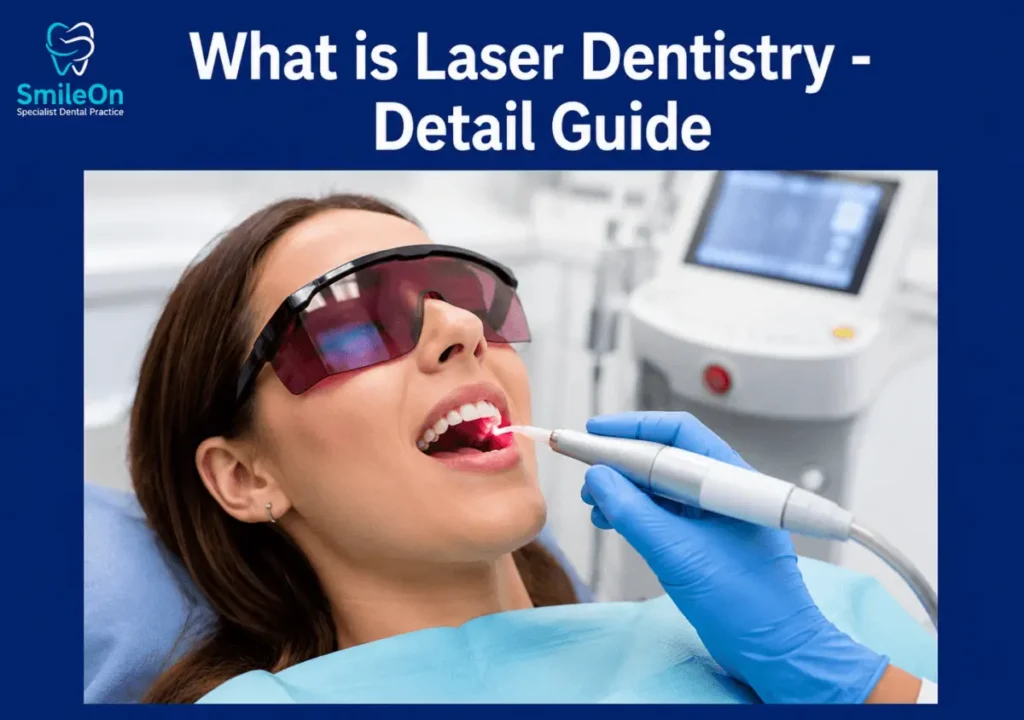
It is a treatment method that uses focused beams of light energy (lasers) to carry out many different types of dental procedures. Laser instruments can replace traditional tools like the drill, scalpel, as dentists use lasers to precisely remove, reshape, or treat the tissue.
Laser Stands for Light Amplification by Stimulated Emission of Radiation. These devices emit focused light energy that can penetrate specific regions inside the mouth while sparing nearby tissues.
Lasers have gained a lot of popularity in dentistry because they can enhance comfort and also may result in more accurate solutions with faster healing time.
How Does Laser Dentistry Work?
Dental lasers emit focused light beams of various wavelengths. Various wavelengths interact with various tissues within the mouth.
At the smaller side of a treatment area, the laser can:
- Remove decayed tooth material
- Reshape gum tissue
- Eliminate bacteria
- Stimulate tissue healing
- Reduce inflammation
- Whiten teeth
- Stop the loss of blood by sealing off bleeding points
The energy of the laser vaporizes unwanted tissue or stimulates biological reactions that promote repair.
As lasers are much more precise, dentists carrying out laser treatment can often save surrounding healthy tissue compared to traditional methods of treatment.
Which Dental Treatments Involve Lasers?
It has a wide variety of uses. Below is a list of the most widely used.
Gum Disease Treatment
Treating periodontal (gum) disease is among the most common uses of laser dentistry.
By gently removing the infected gum tissue and removing toxic bacteria from around the roots of your affected teeth with laser therapy. This reduces inflammation and helps make healthier gums.
Benefits include:
- Less bleeding
- Reduced swelling
- Faster healing
- Improved comfort
Cavity Detection and Treatment
Lasers can detect tooth decay in its infancy, long before becoming noticeable even on X-rays.
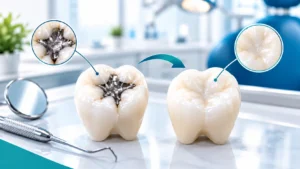
In fact, lasers can also replace traditional dental drills to remove decayed parts of some cavities.
This may assist patients who get anxious at the sound or feel of drilling.
Gum Reshaping and Contouring
Some people have too much gum tissue, producing a so-called “gummy smirk.”
In contrast, laser technology lets dentists reshape the gum line to create a more even and aesthetically pleasing smile.
It is almost always faster and less invasive than regular gum surgery.
Teeth Whitening
One of the most popular cosmetic procedures for teeth whitening is laser whitening.
During treatment:
- We put a whitening gel on the teeth.
- This whitening system uses a dental laser that activates the whitening agent.
- It speeds up the whitening process so you can see results quicker.
- Patients can get a noticeably whiter smile in one session.
Frenectomy Procedures
A frenectomy means removal or adjustment of a small fold of tissue, also known as a frenum.
These are the reasons that may lead to performing this procedure:
- Correct tongue-tie
- Improve speech development
- Enhance oral function
- Support orthodontic treatment
Laser frenectomies typically only take a few minutes and are associated with less bleeding.
Root Canal Therapy
By disinfecting root canals better, lasers can help with Root canal.
The laser is effective because it penetrates deep within the tooth to kill bacteria; this can improve treatment success and prevent reinfection.
Treatment of Mouth Ulcers
This can help reduce the irritation from painful mouth ulcers and canker sores.
The treatment often:
- Reduces pain immediately
- Accelerates healing
- Minimizes irritation
Most patients find considerable relief soon after treatment.
Different Types of Lasers in Dentistry
Dental lasers are not all created equally. Several types are available, each intended for a certain procedure.
Hard Tissue Lasers
These are mainly used on tooth structures and bone.
Common uses include:
- Removing cavities
- Preparing teeth for fillings
- Detecting decay
- Shaping tooth structure
These lasers can selectively target hard dental tissues while conserving adjacent areas.
Erbium Lasers
Erbium lasers have been used in hard and soft tissue applications, often together.
They are particularly effective for:
- Cavity preparation
- Tooth restoration
- Bone procedures
- Gum treatments
These lasers cause a small amount of vibration and discomfort.
Soft Tissue Lasers
Soft tissue lasers are designed for procedures that involve gums and other soft oral tissues.
They are commonly used for:
- Gum disease treatment
- Gum contouring
- Frenectomies
- Oral lesion removal
- Crown lengthening
Soft tissue lasers are able to seal blood vessels while performing treatment, creating less bleeding.
Diode Lasers
Perhaps the most visible and common type of dental laser is a diode laser.
They are effective for:
- Soft tissue surgery
- Gum treatments
- Teeth whitening
- Bacterial reduction
Their adaptability has made them very desirable for policies in contemporary dental practices.
What are the Pros of Laser Dentistry?
Lasers have many advantages that includes:
Greater Comfort
This allows many procedures to be done with minimal or no anesthesia, improving patient comfort during treatment.
Reduced Bleeding
The lasers seal blood vessels while they work, which means if a patient were to undergo an extraction, it would greatly reduce the bleeding that usually takes place.
Faster Healing
Laser treatment is usually high precision, which means increased speed of recovery and reduced injury to tissue.
Lower Risk of Infection
Lasers can be used to sterilize the treatment areas and remove bacteria when performing procedures.
Reduced Need for Sutures
Soft tissue treatments often don’t even need stitches since lasers seal the tissues as they cut.
Improved Precision
Dentists will be able to remove the damaged portions precisely while retaining healthy adjacent tissue.
Less Dental Anxiety
Patients intimidated or put off by drills and scalpels often find laser procedures less frightening.
Cons of Laser Dentistry
Although it has a number of advantages, there are also some drawbacks.
Higher Treatment Costs
Some clinics own laser equipment, but the cost of laser machines is high, which may contribute to treatment costs.
Not Suitable for Every Procedure
While others offer a variety of data-driven techniques, some forms of dental treatments need traditional instruments.
For example:
- Large cavity restorations
- Some crown placements
- Complex tooth extractions
- Availability may be limited
Not all dental practices have advanced laser technology.
Special Training Required
Dental lasers are widely available, but dentists need special training to apply them safely and effectively.
Conclusion
Laser dentistry will literally change the way that many dental procedures are performed by providing accuracy, ease of use, and faster recovery. Dental lasers can be a modern alternative to many traditional procedures, whether you need gum disease treatment, cavity removal, gum reshaping, or teeth whitening.
It does not necessarily mean a replacement of conventional techniques in every scenario, but it is indeed yet another way to provide patients with effective and patient-friendly treatment when required.
FAQs
Can kids get laser dentistry?
Yes. In many cases, laser dentistry is appropriate for children and can help your dentist provide treatment for cavities, frenectomies, or gum care. Many kids are more comfortable with laser treatments than traditional dental procedures.
Do gums bleed with lasers?
Laser treatments cause significantly less bleeding than conventional surgical methods, as it seals blood vessels while working.
Can laser whiten teeth?
Yes. One form of cosmetic dental procedure performed frequently is teeth whitening, which activates the agents used while making this process quicker and more obvious.
Does laser dentistry take longer than regular dentistry?
Not usually. Most laser procedures take the same or even less time than traditional treatments and often require less preparation and fewer follow-up visits.